The experience, exam, application, bond and renewal steps every HVAC contractor license shares, with current licensing rules linked for all 50 states.
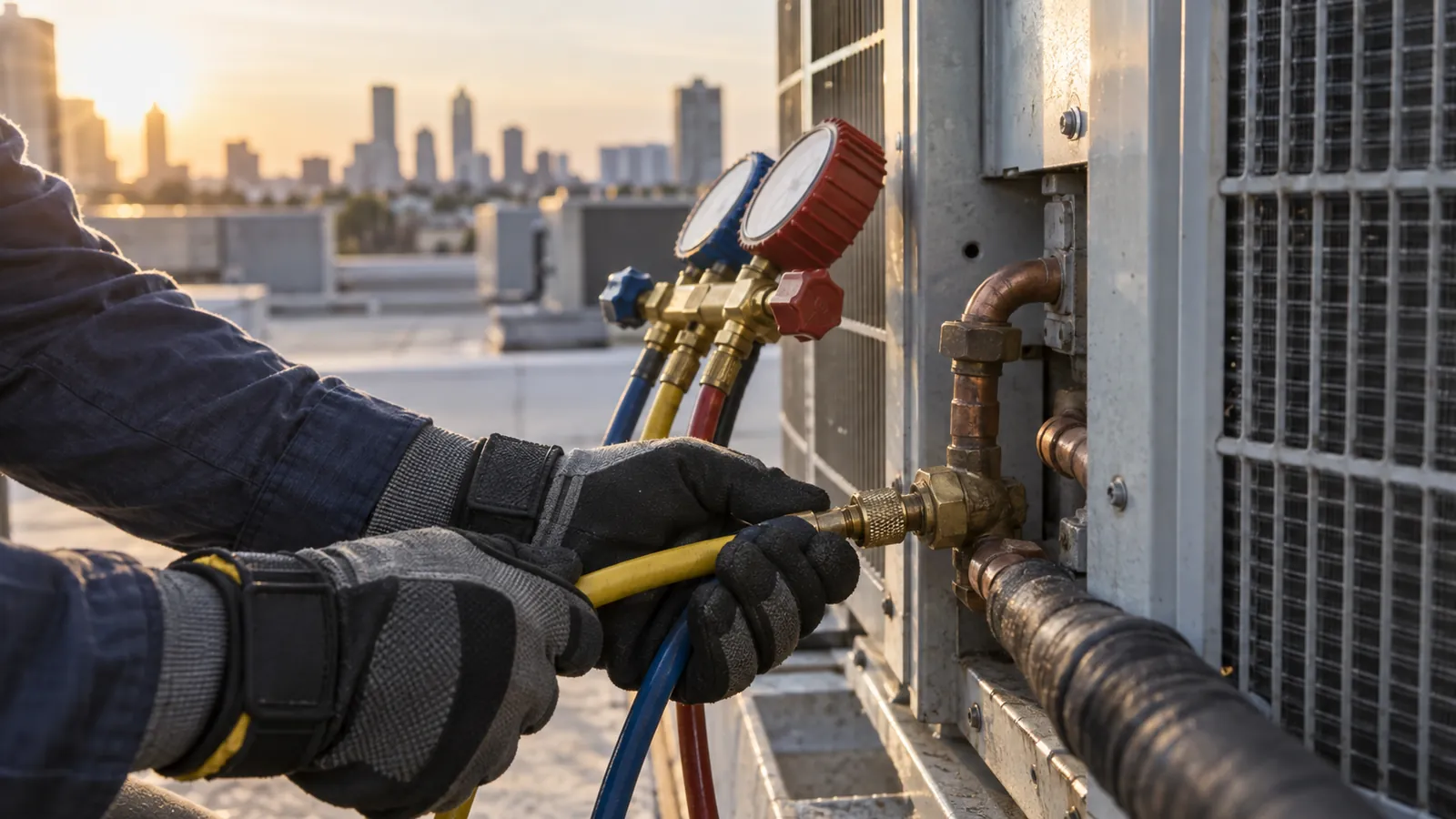
How do you get an HVAC contractor license, the license for heating and air conditioning work? In most states, a board issues the license to a company once one person, the qualifier, proves years of trade experience and passes a trade exam and a business and law exam, and the company then files insurance and often a bond. This guide walks through the path nearly every state uses, the license levels and classes that repeat from board to board, and links the current licensing rules for HVAC contractors in all 50 states.
Technicians who handle refrigerant equipment also need a separate federal credential, EPA Section 608, no matter what the state requires. For how licensing works across every trade, see how to get a contractor license in each state.
At a glance Who issues it: a state licensing board, or a city or county where the state sets no HVAC license. Experience: most boards ask the qualifier for 2 to 5 years in the trade. Exams: a trade exam, plus a business and law exam in states such as Florida, California, Nevada and Tennessee. Money proof: insurance, plus a bond or a credit or financial test in many states. Federal layer: EPA Section 608 for anyone who services refrigerant equipment; it does not expire.
What an HVAC Contractor License Covers and Who Needs One
An HVAC contractor license is a business credential: it lets the company bid jobs, sign contracts and pull permits for heating, cooling, ventilation and refrigeration work. A technician credential, where a state issues one, covers the person doing hands on service and sits as a separate layer from the company's contractor license.
The name changes by state. Florida certifies air conditioning contractors in Class A and Class B, plus mechanical contractors; California issues the C-20; Nevada the C-21; and Arizona the C-39. North Carolina licenses heating groups rather than a single HVAC class, and most boards size the license to the equipment, so a limited class tops out at a set number of tons or Btu while an unlimited class covers any size job.
Every licensing state ties its requirement to the scope of work rather than one dollar figure that holds nationwide, so a state's own board page is the only reliable source for its trigger. Tennessee, for example, licenses HVAC work as a CMC-C contractor once a project, including a subcontractor's HVAC portion, reaches $25,000.
Florida also splits its certificate holders into two tiers worth knowing before you apply. Under Fla. Stat. 489.105(8), a certified contractor holds a DBPR certificate of competency and can contract anywhere in the state without meeting a local jurisdiction's own competency rules. A registered contractor under 489.105(10) has only met one city's or county's requirements and may contract in that jurisdiction alone, which is why a company moving between Florida counties usually wants the certified route rather than a new local registration each time.
The Path Every State Shares
Licensing boards build the HVAC contractor license from the same handful of parts, even when the numbers and the order change from board to board. Expect some mix of documented experience, a trade exam, a business and law exam, a state application and fee, insurance, a bond or financial test, and a renewal cycle, with continuing education required in some states.
| Requirement | What boards ask for | Example |
|---|---|---|
| Experience | Years in the trade, documented | Nevada: 4 years within the last 15 |
| Trade exam | HVAC scope, codes, design | Georgia: minimum score of 70 |
| Business and law exam | Contracts, lien law, business rules | California Law and Business exam |
| Application | State form and fee | Texas: $115 application fee |
| Insurance | General liability, often more | Ohio: $500,000 contractor liability |
| Bond or financial proof | Surety bond, credit score or a CPA statement | California: $25,000 license bond |
| Renewal | Fixed cycle, continuing education in some states | Florida: 14 hours each renewal |
| Qualifier | One licensed person tied to the company | Arizona: requalify within 60 days |
Notes
- California's bond rose to $25,000 on January 1, 2023 under SB 607; a bond of qualifying individual applies when a responsible managing employee, or an officer who owns less than 10 percent of the voting stock, qualifies the license.
- Nevada sets its contractor bond anywhere from $1,000 to $500,000, scaled to the monetary limit the board assigns, plus a financial statement at every limit.
- Alabama requires a $20,000 performance bond and a $220 annual active status fee only from contractors with active status; inactive license holders need neither.
- Tennessee has let a surety bond of at least 50 percent of the requested limit stand in for a reviewed or audited financial statement since July 1, 2026.
- Washington asks for $200,000 of public liability and $50,000 of property damage coverage, or $250,000 combined, on top of its specialty contractor bond.
- Texas lists no statewide bond for its ACR contractor license on the TDLR page; the board asks instead for a general liability insurance certificate.
Training can offset experience in some states. North Carolina lets up to half of its required 4,000 hours be academic or technical training, Georgia credits a technical school diploma in engineering or engineering technology as no more than two years, and Arizona lets accredited training offset part of its four year requirement as long as at least two of those years fall within the last ten. Exams commonly come in two parts, a trade exam on HVAC scope and codes and a business and law exam on contracts and lien law, and the two parts are not always run by the same vendor.
License Levels and Classes That Recur
A few license levels repeat across states even when the names differ. A technician certification covers hands on service and can sometimes count toward a contractor license; Texas lets 12 months of technician certification stand in for part of its experience requirement. A journeyman level shows up inside some boards' qualifier rules, and Nevada will accept a current master certification in place of its usual work experience certificates.
The contractor license itself usually comes in a limited and an unlimited version. Florida's Class B tops out at 25 tons of cooling and 500,000 Btu of heating in one system, while its Class A and mechanical contractor licenses carry no size limit. Texas draws the same line between its Class A, which covers any size unit, and its Class B, capped at 25 tons of cooling and 1.5 million Btu per hour of heating. Georgia's Class I license stops at 175,000 Btu of heating and 60,000 Btu of cooling, with Class II left unrestricted, and North Carolina's heating groups split the same way by tonnage, except that systems in single family homes fall under Group 3 at any size.
A search for a "warm air license" or an "ac license" usually points to the same credential under a different name. California's C-20 is formally the Warm-Air Heating, Ventilating and Air Conditioning Contractor classification, and most of the plain language searches for an "ac contractor license" or a "certified air conditioning contractor" describe the air conditioning or mechanical contractor license a state board already issues, not a separate category. A journeyman card is a different thing again: it is usually a local or state technician credential a person earns before they ever sit for the contractor license's business and law exam, and it does not by itself authorize a company to contract.
Reciprocity and NASCLA for HVAC Contractors
NASCLA, the National Association of State Contractors Licensing Agencies, runs a single accredited exam that a number of states accept in place of their own trade exam. That exam is built for commercial general building contractors and for electrical trades, and NASCLA does not offer a parallel HVAC exam. A NASCLA credential can still help an HVAC company that also wants a general contractor license, but it does not stand in for the HVAC trade exam itself.
Because no national HVAC exam exists, reciprocity between states runs through each board's own rule rather than one shared system. Some boards will credit an active out of state HVAC license toward part of the experience requirement; most still require their own trade exam, their own business and law exam where one applies, and their own application. Check the state by state list below, or call the board directly, before assuming a license will transfer.
In practice, a board that gives any credit for an out of state HVAC license still asks for paperwork rather than a one line credential swap: a work history that matches its own experience rule, and in many cases its own trade exam even where its business and law exam is waived. Georgia's own application, for example, does not separate in state from out of state experience; it asks every applicant for the same three references regardless of where the work was performed.
EPA Section 608: The Federal Layer
EPA Section 608 certification is required of technicians who maintain, service, repair or dispose of equipment that could release refrigerant into the air, no matter what the state requires. EPA approved certifying organizations give the test, and the credential does not expire.
| Certification | Equipment covered |
|---|---|
| Type I | Small appliances |
| Type II | High or very high pressure appliances |
| Type III | Low pressure appliances |
| Universal | All types of equipment |
Notes
- Small appliance: under 40 CFR 82.152, a factory sealed appliance holding five pounds or less of refrigerant, such as a refrigerator or a window unit.
- Type II: excludes small appliances and motor vehicle air conditioners.
- Apprentices: exempt while closely and continually supervised by a certified technician.
- Universal: requires a proctored core test.
For how the federal card and a state license fit together, see EPA 608 certification vs an HVAC license.
What an HVAC License Costs and How Long It Takes
Application and exam fees are set state by state and do not move in step with each other. Texas charges $115 to apply for its ACR contractor license, Washington charges $150.20 to register as a contractor, and Alabama charges a $175 exam fee plus a separate $220 annual active status fee tied to its bond. None of these figures include a bond premium, insurance, fingerprinting or a background check, which the state collects on its own schedule.
Timeline runs on two tracks that rarely move together. The experience clock is the long one, and it runs for years before an application is even filed; a qualifier who already has the hours can usually clear the exam and paperwork stage in weeks rather than months. Exam scheduling itself can still add time: Florida requires candidates to register with Professional Testing, Inc. and wait for that approval before Pearson VUE will book the computer based test, and a NASCLA accredited exam application, where a state's general building side accepts one, is typically processed within 7 business days and stays valid for a year with up to three attempts.
Renewal resets on its own calendar in most states. Florida certificate holders renew every two years and complete 14 hours of continuing education each cycle, while other boards tie renewal to the same annual or biennial cycle as their active status fee. Missing a renewal deadline, rather than the original application, is the most common reason a company ends up relicensing from scratch.
States Without a Statewide HVAC Contractor License
Pennsylvania has no statewide contractor license: the Department of Labor and Industry says the state has no licensure or certification requirements for most construction contractors. Home improvement work still needs registration with the Attorney General once it reaches $5,000 a year, and some of the state's municipalities set their own rules.
Washington does not issue a standalone HVAC license either. The company registers as a contractor with the Department of Labor and Industries, buys a $15,000 specialty contractor bond, carries liability insurance, and pays a $150.20 application fee.
Two states often placed on the unlicensed list actually do license HVAC. Michigan licenses mechanical contractors through LARA, with a minimum of 3 years of experience in each work classification applied for and a PSI exam for each. Ohio's Construction Industry Licensing Board licenses commercial HVAC contractors, requiring 5 years as a tradesperson, a passing exam and at least $500,000 of contractor liability coverage.
When the Company Needs a Qualifier
In nearly every licensing state, the company's right to contract for HVAC work rests on at least one licensed person. Florida is typical: under Fla. Stat. 489.119(2), a corporation, LLC or partnership applies through a certified or registered qualifying agent, and that person must hold final approval authority over the construction work and over the business's contracts, checks and payments.
The clock starts running the moment a qualifier leaves. Florida gives the company 60 days to name another qualifying agent once its only one departs, and Arizona requires notice within fifteen days and requalification within sixty days or the license is suspended automatically under A.R.S. 32-1127.01.
New Jersey names a licensed master HVACR contractor as the company's bona fide representative, who must hold at least one percent ownership unless the company earns more than 65 percent of its revenue outside HVACR work or is publicly traded (see what a bona fide representative is). Where a state sets no ownership rule, the lawful model is the same: a licensed professional on the payroll as a full time W-2 employee, never a 1099 arrangement, who actually supervises the work.
A qualifying agent qualifies the company as an owner or a full time W-2 employee who actually supervises the work, not a name placed on a license for a business the agent does not work for. Our founders, Marshall Schofield and Jeremiah Jaskulski, built The Licensing Company around that model. Read what a qualifying agent is, or hire a qualifying agent if your company needs one while a future licensee builds experience.
The Licensing Steps in Order
- Pick the state and the class. Match tonnage, BTU limits and gas piping to the right license.
- Name the qualifier. Decide who sits for the exams and stays tied to the company.
- Document the experience. Most boards want signed statements or certificates; Georgia asks for three references.
- Line up EPA Section 608. Several states' experience and application rules already expect proof of it.
- Apply in the order the board sets. Florida candidates apply with Professional Testing, Inc. before scheduling the computer based exam with Pearson VUE; other boards issue exam eligibility only after the application is filed.
- Pass the exams. Plan for the trade exam and, in many states, the business and law exam.
- File the money proof. Insurance, any bond, and a credit report or financial statement where the state asks for one.
- Keep the license alive. Renew on time and replace a departing qualifier inside the state's window.
Want the Application Done for You?
Every state above runs its own eligibility check, document checklist, state form and submission process, and a board can bounce an application back over one missing piece. The Licensing Company's License Application Processing prepares and submits the state HVAC contractor license application: an eligibility audit before anything is filed, a document checklist where we chase the pieces with you, every state form prepared and reviewed line by line, submission the way the board requires, and the board's paperwork questions answered and resubmitted until the board decides.
It is a flat $999 per state application, paid up front. State fees, exam fees, background checks and fingerprinting are paid to the state, not to us. Call 615-219-2110 or start with License Application Processing; we do not promise approval, a timeline, or sit the exam for anyone.
HVAC License Requirements in Every State
Every board sets its own experience, exam, fee and bond rules, and the figures above are sourced examples, not numbers that hold everywhere. Find your state below for its HVAC contractor license page, with current figures and a link to the board.
Mistakes That Stall an HVAC License
- Skipping EPA 608. A state license does not replace it.
- Buying a bond the state does not require. Florida proves finances by credit score or a course; check what the county adds on top.
- Ignoring local rules where there is no statewide license. The city or county decides instead.
- Letting the qualifier gap run past the deadline. Sixty days goes fast in Florida and Arizona once a qualifier leaves.
- Skipping continuing education. Florida requires 14 hours each renewal cycle.
Frequently Asked Questions
What states require an HVAC license? Most do. Every state in the list above except Pennsylvania issues some form of statewide HVAC, mechanical or conditioned air contractor license, and Washington requires contractor registration with a bond in place of a dedicated HVAC license. Each board sets its own rule, so use the state list above for the current figures where you do business.
What states do not require an HVAC license? Pennsylvania has no state licensure for most construction contractors, and Washington has only contractor registration with a bond. Michigan and Ohio are sometimes listed as unlicensed, but both actually license HVAC contractors, and cities and counties often fill the gap elsewhere.
Does Florida require a bond for a mechanical contractor? Not at the state level. Rule 61G4-15.006 accepts a credit score of 660 or higher, or a 14 hour financial responsibility course, with no unsatisfied judgments or liens. Fla. Stat. 489.115(7) lets the board's financial stability guidelines include bonding of no more than $10,000 for Division II certificate holders, but the current rule adopts only the credit score and the course. A county or city may require a local bond of no more than $5,000, and a financially responsible officer needs a $100,000 bond or an irrevocable letter of credit.
How long does it take to get an HVAC contractor license? Experience is the long part, from 2 years in some states to 5 years in others, and a handful of boards layer on a waiting period for exam approval before the trade and business exams themselves. See how long it takes to get a contractor license for the full timeline.
Is EPA 608 certification the same as an HVAC license? No. EPA 608 certifies the technician under federal law; the state license authorizes the company to contract.
What insurance does a Pennsylvania HVAC contractor need? For home improvement work, Pennsylvania's registration law requires at least $50,000 of personal injury liability coverage and $50,000 of property damage coverage, once a contractor reaches $5,000 or more of home improvement work a year. Cities may add their own license rules on top.
Can my company get an HVAC license if I am not licensed myself? Yes, in most states, through a qualifier. Florida, Arizona, California, Nevada and Tennessee all license the business through a qualifying person who meets the experience and exam rules and actually supervises the work.
What is a warm air license? It is usually the same credential as an HVAC or air conditioning contractor license under an older name. California's C-20 classification is still formally titled Warm-Air Heating, Ventilating and Air Conditioning Contractor, and a handful of other state and local programs use similar wording for the same scope of work.
Does the NASCLA exam cover HVAC contractors? No. NASCLA's accredited exam program covers commercial general building contractors and electrical trades; it has no HVAC specific exam, so reciprocity for an HVAC license still runs through each state's own board rather than through NASCLA.
Do I need a bond for an HVAC contractor license? It depends on the state. California requires a $25,000 contractor license bond, Nevada sets its bond between $1,000 and $500,000, and Alabama requires a $20,000 performance bond for active status contractors, while Florida and Texas ask for insurance and a financial or credit test instead of a statewide bond.
Talk With Our Team About Your HVAC License
If your company needs an HVAC contractor license in a new state, or a qualifier just gave notice, call 615-219-2110 or start on the hire a qualifying agent page. Our team, led by founders Marshall Schofield and Jeremiah Jaskulski, will walk you through the board's steps, the qualifier it requires, and License Application Processing if you want the paperwork handled for you.
Sources
All retrieved and verified 2026-10-08.
- Florida Statutes 489.105, 489.111, 489.115, 489.119, 489.131 (Florida Senate)
- Florida Rule 61G4-15.006, Financial Responsibility and Financial Stability (effective 5/5/2024)
- DBPR Construction Examinations, Professional Testing Inc and Pearson VUE
- CSLB bond requirements
- CSLB C-20 classification
- TDLR, Apply for an Air Conditioning and Refrigeration Contractor License
- Nevada State Contractors Board license requirements
- Nevada Administrative Code 624.380, classification C-21
- Arizona Revised Statutes 32-1122
- Arizona Revised Statutes 32-1127.01
- Georgia Rule 121-3-.04, Conditioned Air Contractor License (Georgia Secretary of State)
- North Carolina G.S. 87-21
- Michigan LARA mechanical examination and licensing information
- Ohio Construction Industry Licensing Board, contractors
- Alabama Board of Heating, Air Conditioning and Refrigeration Contractors, how to get licensed
- Tennessee Board for Licensing Contractors, contractor license
- Washington L&I, register as a contractor
- Pennsylvania Department of Labor and Industry, contractor licensing
- Pennsylvania Attorney General, home improvement contractor registration FAQ
- New Jersey P.L. 2019, c. 260, amending N.J.S.A. 45:16A-2, bona fide representative (New Jersey Legislature)
- NASCLA Commercial Exam, participating classifications
- NASCLA, Apply for Exams
- Florida Statute 489.105, contractor definitions (Florida Senate)
- U.S. EPA, Section 608 technician certification requirements
- 40 CFR 82.152 definitions (eCFR)
Disclaimer: This article is provided for educational and informational purposes only. It does not constitute legal advice, licensing guidance, or an offer of services. Licensing requirements vary by jurisdiction. For specific compliance questions, contact The Licensing Company for a confidential consultation.