Florida's licensing board voted down a proposed settlement with the former qualifier of a pool company accused of abandoning projects. What was reported, and what the statutes say about the qualifier seat.
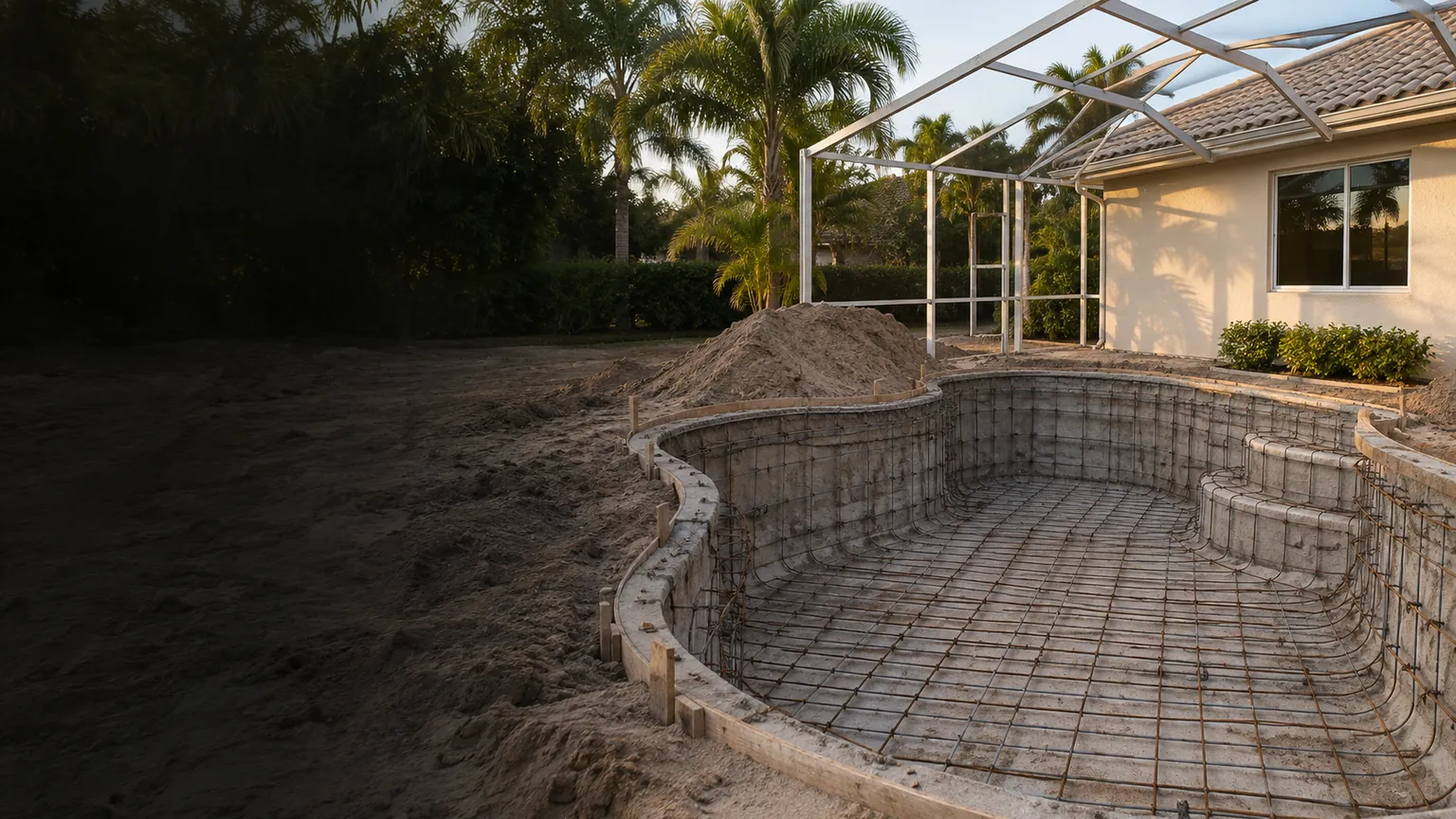
On November 12, 2026, Florida's Construction Industry Licensing Board voted down a proposed settlement with the former qualifier of a Southwest Florida pool company, WINK News reported. The company is accused of abandoning at least 11 projects. No one has been found to have done anything wrong, and this article names no one.
In Florida, a contracting business does not hold its own license. It operates through a qualifying agent, and the state treats that seat as real responsibility. This article covers what WINK reported, what Florida's statutes say about a qualifying agent's duties and the board's tools, and what it means for a company that wants to work in Florida. For the licensing basics, start with the Florida contractor license page.
At a glance
- What happened: on Thursday, November 12, 2026, the Construction Industry Licensing Board met in Safety Harbor and voted down a settlement proposed by the Florida Department of Business and Professional Regulation (DBPR), WINK News reported.
- Who: the former qualifier of a Southwest Florida pool company. The company is accused of abandoning at least 11 projects. These are accusations, and no one is named here.
- The proposed settlement: $12,000 in penalties, $1,500 in fines and two years of probation, according to WINK.
- What the board said: a member asked why the board was not seeking revocation, and another said they favored revoking the license outright, according to WINK.
- What happens next: DBPR says the case will be reviewed for further prosecution, WINK reported.
- Not confirmed: the board's own minutes for the meeting were not posted when this was written, so the account rests on WINK's reporting.
What WINK reported
WINK News reported that the board rejected the settlement DBPR presented at its meeting in Safety Harbor on Thursday, November 12. The station says the pool company is accused of abandoning at least 11 projects and leaving homeowners out tens of thousands of dollars. The settlement would have required the qualifier to pay $12,000 in penalties and $1,500 in fines, with the license on probation for two years.
WINK reported that a board member asked whether abandonment was involved in every one of the jobs. After hearing that it was, the member asked why the board was not seeking revocation. Another member said they favored revoking the license outright. The board then voted the settlement down.
DBPR told WINK the case will be reviewed for further prosecution. WINK reported that the qualifier's license status does not change in the meantime.
The background WINK describes
WINK says the hearing followed a five month investigation. Customers told the station they paid tens of thousands of dollars for pool installations that were left unfinished, with open excavations and property damage. In October, WINK reported, more than a half dozen homeowners spoke to the Collier County Contractors' Licensing Board and presented evidence that 17 of the company's permits had been abandoned in the county since 2024. That county board revoked the qualifier's local permit pulling privileges and referred its findings to DBPR.
The company gave WINK a written statement saying it supports a thorough, fair, fact based review by the appropriate regulatory authorities.
What the report does not say
It does not say which section of Florida law DBPR or the board relied on. It does not say the board has made any finding. A rejected settlement is not a ruling, and the case continues. We are describing the law below in general, as the statute reads. It is not a list of what this case alleges.
What Florida's statutes say about the qualifier seat
We read chapter 489 of the Florida Statutes on the Legislature's website on November 16, 2026.
- The qualifier carries real duty. Section 489.1195 says primary qualifying agents are "jointly and equally responsible for supervision of all operations of the business organization." A business may, with board approval, name a financially responsible officer for the money side. Then the primary qualifying agent oversees all construction activities.
- Secondary agents have a narrower role. A secondary qualifying agent handles field work at the sites where their license pulled the permit and is not responsible for supervising financial matters.
- Abandonment is a ground for discipline. Section 489.129(1)(j) lists abandoning a construction project. A project may be presumed abandoned after 90 days if the contractor ends it without just cause or proper notice to the owner, or goes 90 consecutive days without performing work without just cause.
- The board has a range of tools. Under section 489.129(1), the board can impose probation or a reprimand, suspension, revocation or denial of renewal, restitution to a consumer for financial harm, continuing education, the costs of investigation and prosecution, and an administrative fine of up to $10,000 per violation.
- The business can be reached too. The statute applies to a contractor, a financially responsible officer, or the business organization for which a contractor serves as a qualifying agent. Section 489.129(2) adds a fine of up to $5,000 per violation for a business organization, or its officers or members who participated in a violation or knew or should have known of it and failed to take reasonable corrective action.
For companies that want to work in Florida
Our Florida contractor license page says: "Florida licenses contracting businesses through a qualifying agent rather than licensing the company itself." It adds that a business "must operate through a state licensed qualifying agent," who "carries supervision of the company's work and final approval authority over its construction and business decisions." If the agent leaves, the page says "the business has sixty days from the agent's departure to hire and register a replacement qualifying agent," and "until a new qualifying agent is in place, the business may not contract."
That is the point of this story for a contractor weighing Florida. The qualifier seat is a working role with duties the board takes seriously, not a line on a form. A qualifying agent qualifies a company, and the person in that seat answers to the state for how the work is supervised.
Marshall Schofield and Jeremiah Jaskulski each hold general contractor, master electrician, master plumber and master mechanical licenses, and they built The Licensing Company around helping contractors qualify the right way. If you work in several states, contractor qualifier services explains how The Licensing Company helps with that.
Frequently asked questions
What did the Florida board do? According to WINK News, the Construction Industry Licensing Board voted down a proposed settlement with the former qualifier of a Southwest Florida pool company on November 12, 2026.
Was anyone found to have broken the law? No finding has been reported. The company is accused of abandoning at least 11 projects. DBPR says the case will be reviewed for further prosecution.
What would the settlement have required? WINK reported $12,000 in penalties, $1,500 in fines and two years of probation.
What is a qualifying agent? Our Florida page says Florida licenses contracting businesses through a qualifying agent rather than licensing the company itself, and that the agent carries supervision of the company's work and final approval authority over its construction and business decisions.
What can the Florida board do when it finds a violation? Under section 489.129 it can impose probation, suspension or revocation, restitution to a consumer, continuing education, investigation and prosecution costs, and a fine of up to $10,000 per violation.
What happens if a business loses its qualifying agent? Our Florida page says the business has sixty days to hire and register a replacement, and may not contract until a new qualifying agent is in place.
This article is general education, not legal advice. The Florida Department of Business and Professional Regulation or a Florida construction attorney can confirm how the law applies to a specific business.
Marshall Schofield, one of the nation's leading contractor exam prep instructors, has helped thousands upon thousands of contractors get licensed. Jeremiah Jaskulski is a licensed contractor who has lived the licensing process across multiple states. Together they founded The Licensing Company, and they help contractors get licensed the right way in Florida and nationwide. Sources: the WINK News report of November 12, 2026, and Florida Statutes sections 489.1195 and 489.129 on the Florida Legislature's website, read November 16, 2026.
Disclaimer: This article is provided for educational and informational purposes only. It does not constitute legal advice, licensing guidance, or an offer of services. Licensing requirements vary by jurisdiction. For specific compliance questions, contact The Licensing Company for a confidential consultation.
Tell us the state and the trade. A member of the team calls you back.
We confirm what your board requires for your situation, then match a licensed qualifier who joins your company as a full time W-2 employee. Rather talk now? Call 615-219-2110.
Tell us your state and trade
A member of the team calls you back from 615-219-2110.