California's licensing board says two people behind a former ADU builder are charged with 35 felony counts. What the board announced, the deposit rule it repeated, and what a homeowner can check before paying.
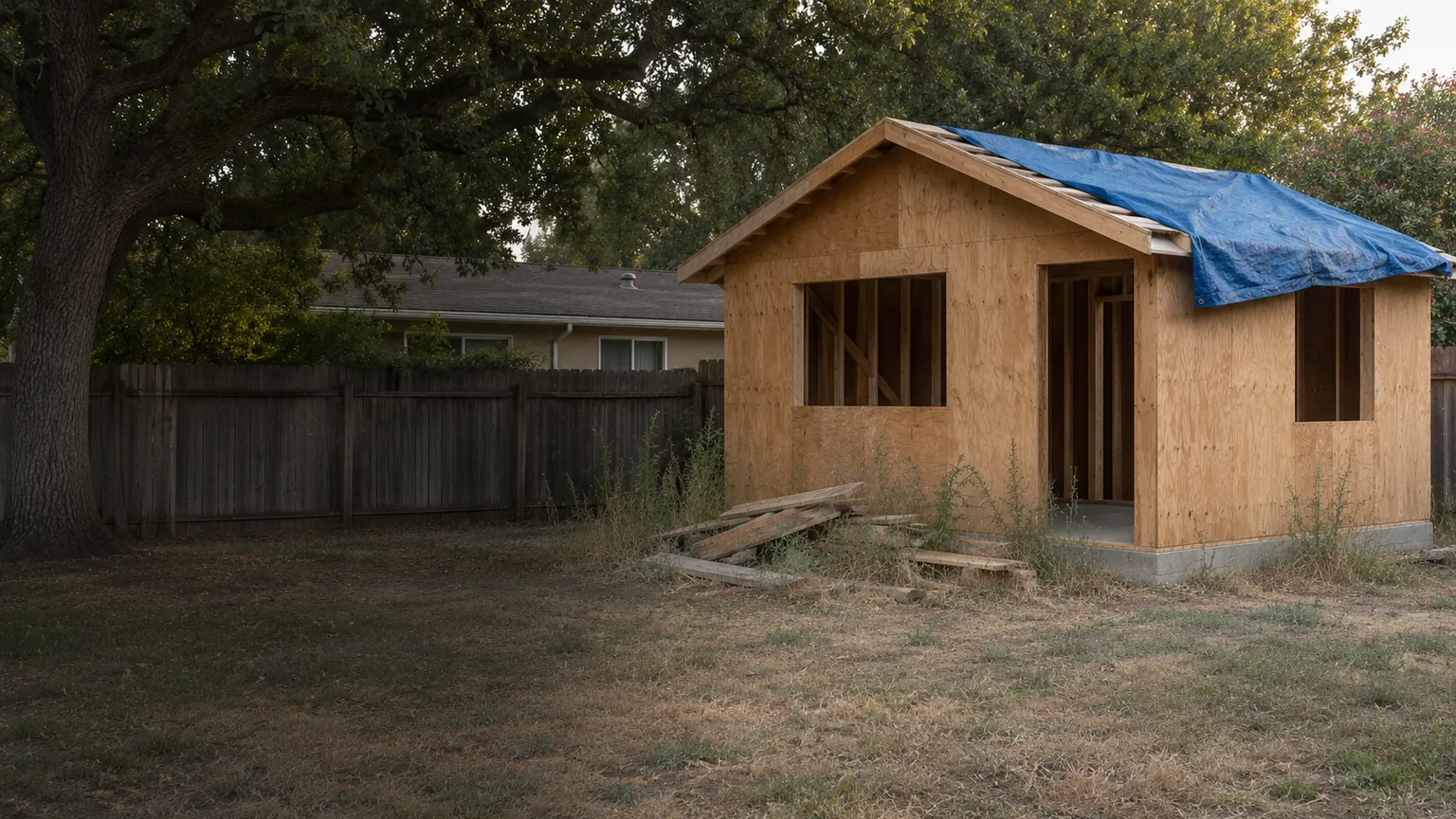
California's Contractors State License Board (CSLB) announced on October 20, 2026 that two people behind a former California ADU builder have been charged with 35 felony counts related to unfinished accessory dwelling unit (ADU) projects. The CSLB and the Sacramento County District Attorney's Office investigated together. These are charges, not convictions, and the two are accused. We do not name them or the former company.
This is a construction funds and consumer payments story, not a licensing story. No source says a license would have prevented any loss, and we do not say that either. The part that touches our work is smaller, and it is useful to any homeowner or contractor. The CSLB used its announcement to remind the public how deposits and progress payments work in California, and a homeowner can check a contractor's license before paying anything. For the full licensing picture, start with the California contractor license page.
At a glance
- Who: two people behind a former California ADU builder. They are charged, not convicted. No one is named here.
- Announced: October 20, 2026, in a CSLB news release (#26-02).
- The charges, per the CSLB: each faces 33 counts of diversion of construction funds, one count of conspiracy to commit a crime, and one count of employee wage theft. That is 35 felony counts each.
- Who investigated: the CSLB and the Sacramento County District Attorney's Office. The CSLB looked at more than 200 consumer complaints across 18 California counties.
- The money, per the complaint as reported by NBC Bay Area: it alleges about $1.05 million was billed for work that was not performed. These are allegations.
- The license, per the CSLB: it says it revoked the company's license in November 2024.
- Next: a hearing is set for January 12, 2027. NBC Bay Area reported that no plea had been entered as of October 14.
What the CSLB announced
The CSLB's release says the two people behind the former company "have been charged with 35 felony counts related to unfinished accessory dwelling unit (ADU) projects." It says each faces 33 counts of diversion of construction funds, one count of conspiracy to commit a crime, and one count of employee wage theft.
The charges follow a long review. The release says the CSLB investigated more than 200 consumer complaints across 18 California counties. Those complaints allege abandoned ADU projects, unpaid subcontractors, payments in advance of work performed or often not performed, and funds paid by homeowners that were not used for the homeowners' projects. The 200 complaints are the board's investigation. They are not a count of charges.
The release also says a settlement conference hearing that had been set for the week before was continued until January 12, 2027. NBC Bay Area reported on a short virtual hearing on October 14 where neither person entered a plea, and the judge ordered both back to court on January 12.
What the complaint alleges about the money
The CSLB's release does not give a dollar figure. NBC Bay Area, which reported on the District Attorney's complaint, says it alleges the company billed customers and received payment of approximately $1,046,433 despite performing no work and supplying no materials. It also says the complaint alleges more than $653,000 was taken from company accounts for expenses and activity unrelated to company projects. These are allegations in a criminal complaint. A court decides what is proven.
The District Attorney's office told NBC Bay Area, "We do not discuss pending cases."
What the CSLB says about the license
The CSLB says that, because of the volume and severity of the allegations, it pursued a criminal investigation and also took what it calls the most serious administrative enforcement action available to the board. It filed an accusation with the California Attorney General's Office seeking revocation of the company's contractor license, and it says it revoked that license in November 2024. After the revocation, the release says, the CSLB kept receiving and investigating consumer complaints, and began referring cases for possible criminal charges with the District Attorney's office.
The release does not say anyone worked without a license, and nothing here suggests it. We did not look anyone up and we say nothing about any person's license.
The payment rule the CSLB repeated
The release also gives a rule for anyone building an ADU. In its words: "Down payments should never exceed $1,000 or 10 percent of the project's total cost, whichever is less. Any additional payments cannot exceed the value of the work performed or material delivered." It says contractors building ADUs must follow California's home improvement payment law restrictions on down payments and progress payments. The board points readers to its "Fast Facts: Tips for Building a Residential Accessory Dwelling Unit (ADU)."
That is the practical part of this story. A homeowner can read a payment schedule against that rule before signing, and a contractor can write the schedule so it follows the rule from day one.
What a homeowner can check before paying a deposit
These are our suggestions, built on what the CSLB says. They are not legal advice.
- Look up the license. The CSLB is the state's licensing authority, and its website, cslb.ca.gov, has a public "License Check". Check that the license is active and that the name matches the name on the contract.
- Read the payment schedule against the CSLB rule. The down payment should not exceed $1,000 or 10 percent of the project, whichever is less, and each later payment should not exceed the value of the work done or material delivered.
- Ask how payments follow the work. A contractor who ties each payment to a finished stage makes the rule easy to follow.
What real contractors can do
- Keep your license record current. The company name on your license, your contract and your invoices should match.
- Write the payment schedule into the contract. Put the down payment within the limit and tie every later payment to completed work or delivered material.
- Pay your subcontractors and your crew on time. The complaints the CSLB describes include unpaid subcontractors, and the charges include one count of employee wage theft.
For companies that want to work in California
California licenses contractors through the CSLB, the sole licensing authority statewide for every construction classification. Our state page says any construction work of $1,000 or more, or any job that requires a building permit or employs workers, takes a license. The CSLB issues licenses in four groups: A, B, B-2 and C. The California contractor license page covers the classifications, the exams and the bond.
California licenses the business, and the business is qualified through a Responsible Managing Officer, who is an owner, partner, officer or member, or a Responsible Managing Employee, who is a bona fide employee with no ownership stake. A Responsible Managing Employee may qualify only one active license at a time. A company whose owners do not yet hold the license can be qualified by a licensed qualifying agent who is a real employee of the company. Contractor qualifier services explains how The Licensing Company helps with that. Not a promise, the board decides.
Frequently asked questions
Who was charged? The CSLB says two people behind a former California ADU builder have been charged with 35 felony counts related to unfinished ADU projects. We do not name them. They are accused, not convicted.
What are the charges? Per the CSLB, each faces 33 counts of diversion of construction funds, one count of conspiracy to commit a crime, and one count of employee wage theft.
How much money is involved? The CSLB gives no figure. NBC Bay Area reports the complaint alleges about $1.05 million was billed for work not performed. That is an allegation, not a finding.
Was the company licensed? The CSLB says it revoked the company's license in November 2024. The release does not say anyone worked without a license.
How much can a contractor ask for as a down payment on an ADU in California? The CSLB says a down payment should never exceed $1,000 or 10 percent of the project's total cost, whichever is less, and later payments cannot exceed the value of the work performed or material delivered.
How can a homeowner check a contractor's license in California? Through the "License Check" on the CSLB website, cslb.ca.gov.
When is the next hearing? The CSLB says a hearing was continued until January 12, 2027.
This article is general education, not legal advice. The CSLB or a California construction attorney can confirm how the law applies to a specific job.
Marshall Schofield, one of the nation's leading contractor exam prep instructors, has helped thousands upon thousands of contractors get licensed. Jeremiah Jaskulski is a licensed contractor who has lived the licensing process across multiple states. Together they founded The Licensing Company, and they help contractors get licensed the right way in California and nationwide. Sources: the Contractors State License Board news release #26-02, October 20, 2026, NBC Bay Area, October 9, 2026, NBC Bay Area, October 14, 2026.
Disclaimer: This article is provided for educational and informational purposes only. It does not constitute legal advice, licensing guidance, or an offer of services. Licensing requirements vary by jurisdiction. For specific compliance questions, contact The Licensing Company for a confidential consultation.
Tell us the state and the trade. A member of the team calls you back.
We confirm what your board requires for your situation, then match a licensed qualifier who joins your company as a full time W-2 employee. Rather talk now? Call 615-219-2110.
Tell us your state and trade
A member of the team calls you back from 615-219-2110.